How Does a Wood Incense Warmer Work? The Beginner's Complete Guide to Smokeless Aromatherapy
You've probably seen Palo Santo sticks and Sandalwood chips sold everywhere — from yoga studios to home goods stores. But every guide you read tells you the same thing: light it on fire, let it burn, blow it out, and fan the smoke around the room.
What if there were a way to enjoy the exact same fragrance — actually, a purer version of it — without any smoke, ash, or fire risk at all?
That's exactly what a wood incense warmer does. And once you understand how it works, you'll wonder why anyone still burns their sacred woods the old-fashioned way.

What Is a Wood Incense Warmer?
A wood incense warmer is a device that uses gentle, indirect heat to release the natural aromatic oils from wood chips, wood shavings, or other botanical materials — without ever setting them on fire.
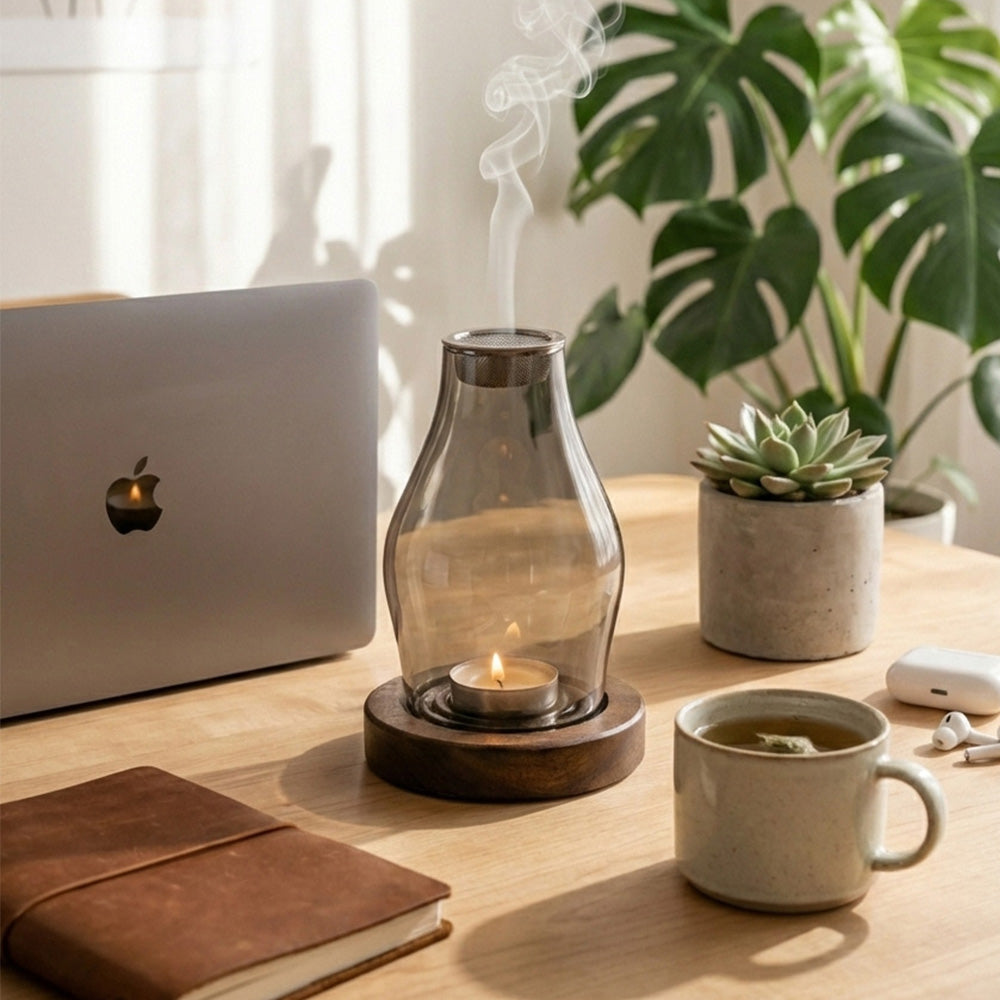
The core design is elegant in its simplicity: a metal mesh screen sits on top, holding your wood chips. Below the screen, a small tealight candle provides a steady, low source of heat. As the warmth rises through the mesh, it slowly heats the wood just enough to release its essential oils into the air.
No combustion. No smoke. No ash. Just pure, botanical fragrance.
This is fundamentally different from the traditional way of using incense wood. When you burn a Palo Santo stick, for example, you're igniting the wood itself. The combustion process destroys a significant portion of the aromatic compounds before they ever reach your nose, and what you smell is actually a mix of the wood's fragrance and the byproducts of burning — carbon particles, soot, and volatile chemicals.
When you warm wood instead of burning it, the temperature stays well below the combustion point. The wood's natural oils evaporate gently and intact, delivering a cleaner, more nuanced fragrance. Many people who try warming for the first time are surprised by how different the same wood smells when it isn't on fire.
How Does It Work? The Science Behind Warming
The principle is straightforward: aromatic compounds in wood are volatile organic molecules. They have specific boiling points, and once the wood reaches those temperatures, the molecules begin to evaporate into the air as fragrance.
Most sacred woods — Palo Santo, Sandalwood, Cedar, Agarwood — contain essential oils that begin to vaporize at relatively low temperatures, typically between 60°C and 150°C (140°F–300°F). A tealight candle generates enough heat to warm the metal mesh screen and the wood chips on it to this range.
Here's what makes this different from burning:
Burning (combustion) happens above 300°C (572°F). At these temperatures, the wood itself breaks down. Cellulose, lignin, and other structural compounds catch fire, producing smoke, soot, and carbon monoxide — along with whatever fragrance oils survive the process.
Warming (evaporation) happens between 60°C and 150°C. At these temperatures, only the volatile aromatic oils are released. The wood structure remains intact. There is no combustion, which means no smoke, no particulate matter, and no harmful byproducts.
Think of it this way: warming extracts the fragrance from the wood. Burning destroys the wood along with the fragrance. The result is that warming actually delivers a purer, more complete scent profile than burning ever could.

The Anatomy of a Tealight Wood Warmer
While designs vary, most tealight-based wood incense warmers share the same basic structure:
The base houses the tealight candle. It's typically an enclosed or semi-enclosed chamber that holds the candle securely and channels the rising heat upward. Good designs allow adequate airflow so the tealight burns steadily without flickering.
The metal mesh screen sits above the tealight chamber and serves as the warming surface. Wood chips and shavings are placed directly on this screen. The mesh allows heat to pass through evenly while keeping the wood material elevated above the flame — never in direct contact with fire.
The body connects the base to the screen and determines the distance between the flame and the wood. This distance matters: too close and the wood may char; too far and the heat may be too weak to release the oils effectively. Well-designed warmers get this distance just right, creating a consistent warming zone.
Some warmers, like the Wispoak Botanical Warmer, take this further by crafting the body from natural wood (such as black walnut) and high-borosilicate glass. As the entire device warms up, the wooden body itself begins to release its own subtle fragrance — creating a dual-source scent experience that's impossible with ceramic or metal warmers. The wood whispers alongside whatever you've placed on the screen.
What Can You Warm? (And What You Shouldn't)
A wood incense warmer with a metal mesh screen is specifically designed for dry botanical materials. Here's what works beautifully:
Palo Santo chips and shavings are perhaps the most popular choice. When warmed, Palo Santo releases its signature citrus-mint-vanilla aroma in full, without the sharp smoky edge you get from burning. The fragrance is sweeter, softer, and longer-lasting.
Sandalwood chips respond exceptionally well to warming. The low, slow heat draws out Sandalwood's creamy, woody depth — notes that can get lost in the harshness of direct burning. Warmed Sandalwood is a meditation favorite for good reason.
Cedar chips offer a clean, dry warmth that's both calming and clarifying. Cedar's natural oils include cedrol and thujopsene, which are known for their calming effects on the nervous system. Warming releases these compounds gently over hours.
Agarwood (Oud) chips — if you have access to them — are traditionally enjoyed this way in many Asian and Middle Eastern cultures. In fact, the Japanese art of Koh-do ("the way of fragrance") has used heating rather than burning as its preferred method for centuries.
Hinoki (Japanese Cypress) delivers a clean, forest-bathing-like experience when warmed. It's a favorite for creating a spa-like atmosphere at home.
Dried herbs and loose botanicals such as lavender buds, rosemary, or dried citrus peel can also be placed on the screen for gentle aromatic release, though results vary by material.
What NOT to put on a mesh-screen warmer: wax melts, essential oil liquids, resins (which need higher temperatures and may drip through the mesh), or any material that melts into liquid. This type of warmer is designed for dry materials only.
How to Use a Wood Incense Warmer: Step by Step
The beauty of this device is its simplicity. No buttons, no cords, no settings to adjust.
Step 1: Choose your wood. Select the wood chips or shavings that match your mood. Palo Santo for energy and clarity. Sandalwood for calm and grounding. Cedar for focus and stillness. Or mix them for a custom blend.
Step 2: Place the wood on the mesh screen. Spread a small amount of chips or shavings evenly across the metal screen. You don't need much — a pinch or small handful is usually enough. Overfilling can block airflow and reduce the warming effect.
Step 3: Light the tealight candle. Place a standard tealight candle in the base chamber and light it. The flame is fully contained within the base, away from the wood material above.
Step 4: Wait. Within 5 to 10 minutes, you'll begin to notice the fragrance filling the room. It starts subtle and builds gradually — this is the "slow warming" effect. The experience is unhurried and meditative, nothing like the sharp burst of smoke you get from burning.
Step 5: Enjoy. A single tealight typically burns for 4 to 6 hours, providing a long, steady aromatic session. You can adjust the intensity by adding or removing wood chips from the screen.
Step 6: When you're done. Let the tealight burn out naturally, or blow it out. Once cool, the wood chips on the screen can be saved and reused. Most wood chips can be warmed multiple times before their fragrance is fully exhausted — typically 3 to 5 sessions, depending on the wood type and chip size.
Step 7: Compost when done. Once the wood chips no longer release fragrance, they can go straight into your garden or compost. Used wood chips return to the earth as natural organic matter. Zero waste.

Warming vs. Burning: Why It Matters
If you've been burning Palo Santo sticks or Sandalwood in a traditional incense holder, you might wonder: is the switch really worth it?
Here's a clear comparison:
| Burning | Warming | |
|---|---|---|
| Smoke | Yes — visible smoke, soot | None |
| Ash | Yes — residue and cleanup | None — wood stays intact |
| Fragrance purity | Mixed with combustion byproducts | Pure essential oil vapor |
| Fragrance duration | Brief (2–5 minutes per stick) | Extended (hours per session) |
| Fire risk | Open flame + smoldering embers | Contained tealight only |
| Material usage | Wood consumed rapidly | Wood reusable 3–5 times |
| Indoor air quality | Particulate matter released | No particulates |
| Apartment-friendly | Often triggers smoke alarms | No smoke alarm risk |
The biggest surprise for most people is the fragrance difference. Warmed Palo Santo smells noticeably different from burned Palo Santo — sweeter, more complex, with delicate notes that combustion simply destroys. Once you experience the warmed version, the burned version often feels harsh by comparison.
Common Questions About Wood Incense Warmers
Do wood chips catch fire on the warmer?
No. The metal mesh screen keeps the wood elevated above the flame, and the indirect heat stays well below the wood's ignition temperature. The chips warm and release oils, but they don't burn.
How many times can I reuse the same wood chips?
Most high-quality wood chips can be warmed 3 to 5 times before the fragrance fades completely. You'll notice the scent becoming lighter with each session — that's your signal to refresh them.
Does it really produce zero smoke?
Yes. Because the wood never reaches combustion temperature, there is no smoke, no soot, and no ash. This makes it ideal for apartments, dorm rooms, bedrooms, and any space where smoke would be a problem.
What kind of tealight candles should I use?
Standard unscented tealight candles work perfectly. If you want a purer experience, look for beeswax or soy tealights, which burn cleaner than paraffin. Avoid scented tealights — they'll interfere with the wood's natural fragrance.
Can I blend different woods together?
Absolutely. Mixing Palo Santo with Sandalwood creates a beautiful balance of bright and deep notes. Cedar and Palo Santo together offer both clarity and grounding. Experimentation is encouraged — it's part of the ritual.
Is it safe to leave unattended?
Like any device with an open tealight, it should not be left completely unattended. However, because the flame is enclosed in the base and the wood material never ignites, the risk is significantly lower than traditional incense or candles. Always place it on a stable, heat-resistant surface away from curtains and other flammable materials.
How does this compare to an electric incense burner?
Electric incense burners offer precise temperature control and true "hands-free" operation, but they require a power outlet and tend to have a more clinical, less atmospheric quality. Tealight-based warmers offer portability, a warm ambient glow, and a sense of ritual that electric devices can't replicate. It comes down to what you value: precision or presence.

The Ritual of Slow Warming
There's one more dimension to wood incense warming that often goes unmentioned: the experience itself.
In a world designed for speed — instant streaming, same-day delivery, one-click everything — there is something quietly radical about choosing to slow down. Selecting the wood. Placing the chips on the screen. Lighting the tealight. Waiting for the first whisper of fragrance to reach you.
This isn't a hack or a shortcut. It's a practice. A small daily ritual that asks you to be present for a few minutes, to notice what's happening in front of you, and to let the fragrance arrive on its own schedule rather than yours.
The Japanese have a word for this kind of attentive engagement with scent: monkō (聞香) — literally "listening to incense." Not smelling it. Listening to it. The idea is that truly experiencing fragrance requires a quality of attention that goes beyond the nose. It asks for stillness, patience, and receptivity.
That's what slow warming offers. Not just a better way to fragrance your space, but a better way to be in your space.
This is the philosophy we built Wispoak around. Our Botanical Warmer is crafted from real black walnut wood and borosilicate glass, designed to warm sacred woods gently on a metal mesh screen — no electricity, no complexity, no rushing. Just wood, glass, flame, and time.