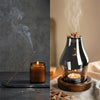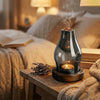
Warming vs. Burning: Why the Way You Fragrance Your Home Actually Matters
Let's start with an honest question: have you ever really thought about what happens when you light a candle or burn a stick of incense?
Most of us haven't. We light the match, enjoy the fragrance, and never consider what's happening at the molecular level — or in our lungs. Candles and incense have been part of human culture for thousands of years, and they feel inherently safe. They're sold in wellness shops, yoga studios, and luxury home stores. How bad could they be?
The answer is nuanced. They're not "bad" in the way cigarettes are bad. But burning anything — whether it's paraffin wax, plant-based wax, or sacred wood — produces byproducts that most people don't realize they're breathing. And there's now a genuinely better alternative that delivers a purer, longer-lasting fragrance experience without any of those tradeoffs.
It's called warming. And the difference is larger than you'd expect.

What Actually Happens When You Burn a Candle
When you light a candle, you're initiating a combustion reaction. The heat from the flame melts the wax near the wick, the liquid wax is drawn up the wick by capillary action, and it vaporizes at the tip of the flame. There, it reacts with oxygen in the air — that reaction is what produces both light and heat, which keeps the cycle going.
This process also produces byproducts. According to a Cleveland Clinic pulmonologist interviewed by TODAY, burning a candle releases particulate matter (soot) and volatile organic compounds (VOCs) into the air, including trace amounts of formaldehyde and benzene — both classified as carcinogens.
Now, before you throw out every candle you own: the concentrations are very low, and for occasional use in a well-ventilated room, the health risk is minimal. Experts generally agree that a single candle isn't going to cause you serious harm.
But "minimal risk" is different from "no risk." And when you burn candles regularly — every evening, in a small bedroom, with the windows closed — those trace exposures accumulate. The soot deposits on walls, ceilings, and fabrics. The VOCs linger in the air long after the flame is out. And the fire risk, while statistically small for any individual candle, is not trivial at scale.
Between 2018 and 2022, U.S. fire departments responded to an estimated 5,910 home fires started by candles per year. These fires caused an average of 74 deaths and 558 injuries annually, along with hundreds of millions of dollars in property damage, according to the National Fire Protection Association (NFPA). A third of these fires started in bedrooms — often because someone fell asleep with a candle burning.
None of this means candles are evil. It means that burning, as a method of releasing fragrance, comes with inherent costs that we've simply accepted because there weren't better alternatives.
Now there are.

What Happens When You Burn Incense
If candles have some downsides, traditional incense amplifies them.
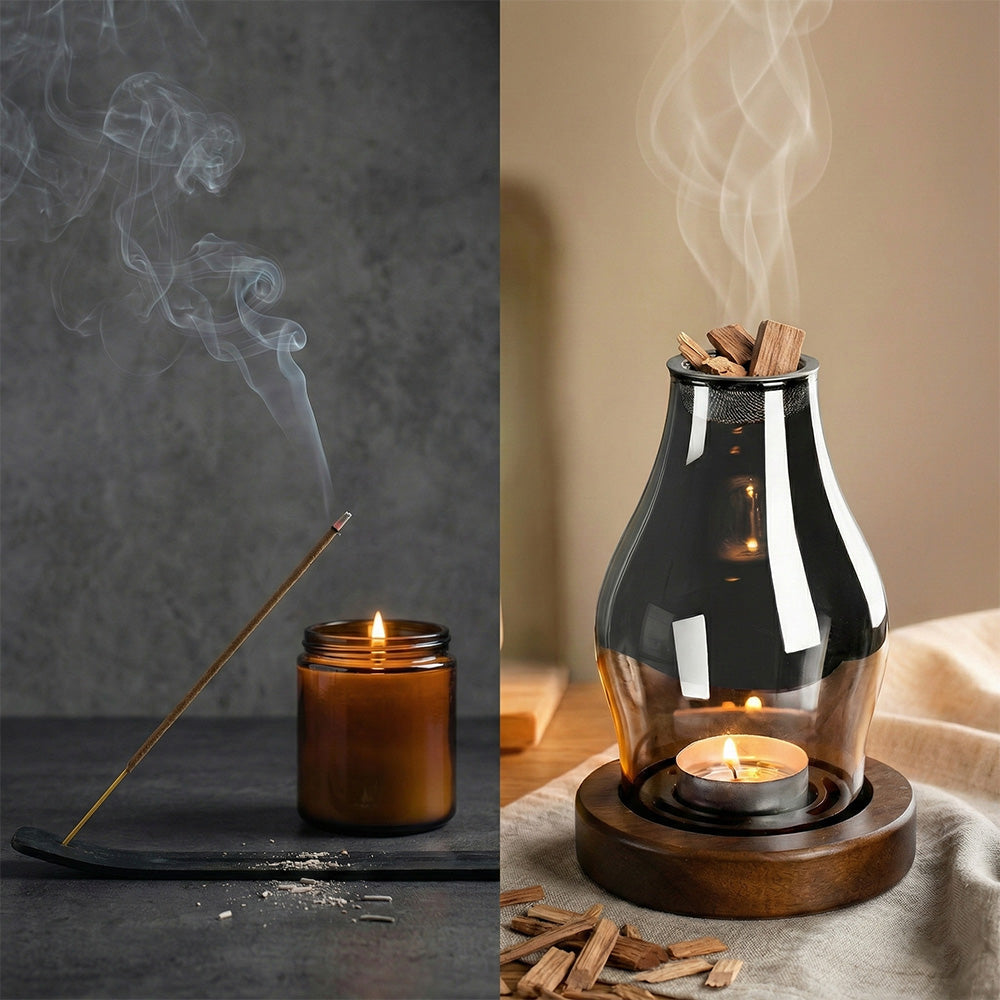
When you light a stick of incense — or a bundle of sage, or a Palo Santo stick — you're combusting solid plant material directly. The temperature at the burning tip reaches 400–700°C (750–1300°F), and at those temperatures, the wood or plant material breaks down rapidly. Some of the aromatic compounds vaporize and reach your nose as fragrance. But a significant portion is destroyed by the extreme heat, and what you're actually smelling is a mixture of essential oil vapor and combustion byproducts: carbon particles, carbon monoxide, nitrogen oxides, and a dense cocktail of volatile chemicals.
That's the smoke. And while many people enjoy the visual and sensory quality of incense smoke, there's a growing body of research documenting what it does to indoor air quality.
A 2023 review published in Applied Sciences examined aromatic substances released by burning incense and found that incense smoke contains fine particulate matter (PM2.5 and PM10), polycyclic aromatic hydrocarbons (PAHs), benzene, formaldehyde, and carbon monoxide — many of the same pollutants found in cigarette smoke, though at different concentrations. The researchers concluded that regular incense use in poorly ventilated spaces could negatively impact respiratory health over time.
Again, context matters. Burning a Palo Santo stick for five minutes in a well-ventilated room is not the same as chain-smoking. But for people who burn incense daily — especially in apartments without great airflow — the cumulative exposure is worth considering.
And here's the less-discussed problem: combustion is an incredibly wasteful way to experience fragrance.
When you burn a Palo Santo stick, the fire destroys the wood's cellular structure along with a large portion of the volatile aromatic compounds you're trying to enjoy. The essential oils in Palo Santo — limonene, alpha-terpineol, menthofuran — have specific vaporization points well below the combustion temperature. At 400°C+, these molecules don't gently evaporate; many of them break apart. What survives the fire reaches your nose as a simplified, smokier version of the wood's true scent profile.
You're getting maybe 30–40% of what the wood has to offer. The rest goes up in smoke. Literally.

The Third Option: Warming
Warming is neither burning nor diffusing. It's a distinct method that sits between the two — preserving the ritual quality of fire-based aromatics while eliminating their downsides.
Here's how it works: you place dry botanical materials — wood chips, wood shavings, dried herbs — on a metal mesh screen above a gentle heat source, typically a tealight candle. The rising heat warms the materials to the temperature range where their essential oils begin to evaporate (typically 60–150°C / 140–300°F) without ever reaching the combustion point (above 300°C / 572°F).
The materials warm. The oils evaporate. The fragrance fills the room. And that's it.
No combustion means no smoke. No smoke means no soot, no particulate matter, no VOCs from burning, no carbon monoxide, and no residue on your walls or fabrics. The fragrance you experience is the pure, unaltered vapor of the wood's natural essential oils — the same molecules that scientists study for their therapeutic benefits, delivered intact rather than partially destroyed by fire.
The scent difference is immediately noticeable. People who try warming Palo Santo for the first time after years of burning it often describe the experience as a revelation. The smoky harshness disappears entirely. In its place, they discover layers of sweetness, citrus, mint, and vanilla that fire had been obscuring all along. The wood's real fragrance is more complex, more nuanced, and more beautiful than its burned version — because you're finally experiencing all of it.
The Full Comparison: Burning vs. Warming
| Candle | Incense (Burning) | Wood Warming | |
|---|---|---|---|
| Smoke | Minimal soot | Heavy visible smoke | None |
| Particulate matter | Low (from wick) | High (PM2.5, PM10) | None |
| VOCs released | Trace (formaldehyde, benzene) | Significant (PAHs, benzene, CO) | None from combustion |
| Fire risk | Open flame; 5,900+ home fires/year (NFPA) | Smoldering embers; contact with surfaces | Contained tealight only |
| Fragrance purity | Synthetic or mixed with combustion byproducts | Mixed with smoke and carbon | Pure essential oil vapor |
| Fragrance duration | 4–8 hours per candle | 2–5 minutes per stick | 2–4 hours per session; reusable 3–5x |
| Material consumed | Wax burns away completely | Wood consumed in single use | Wood reusable across multiple sessions |
| Residue | Soot on walls, glass jars | Ash, smoke stains, residue | None |
| Triggers smoke alarms | Rarely | Often | Never |
| Apartment-friendly | Usually | Often problematic | Completely |
| Cost per session | $1–3 (quality candle) | $0.50–1 per stick | $0.30–0.50 (chips reused) |
What Warming Preserves That Burning Destroys
This is the part that surprises most people. Warming doesn't just eliminate the negatives of burning — it fundamentally improves the fragrance experience.
More Complete Scent Profiles
Every aromatic wood contains dozens of volatile compounds, each with its own vaporization temperature. When you burn wood at 400°C+, you get a homogenized blast of whatever survives the heat. When you warm it at 80–120°C, the compounds release in sequence — the lightest and most volatile first, followed by deeper, heavier notes over time. The result is a fragrance that evolves throughout your session, revealing layers that burning simply incinerates.
Sandalwood is a perfect example. When burned, it smells warm and woody — pleasant, but one-dimensional. When warmed, it unfolds into cream, vanilla, soft spice, and a honeyed sweetness that lingers for hours. The alpha-santalol compound — the one researchers have linked to reduced anxiety and improved sleep — vaporizes well below combustion temperature. Warming delivers it intact. Burning partially destroys it.
Longer-Lasting Sessions
A stick of Palo Santo burns for 2–5 minutes, then it's gone. Wood chips on a warmer release fragrance for 2–4 hours per session, and the same chips can be reused 3–5 times before their essential oils are fully depleted. You use less material, generate less waste, and get dramatically more fragrance time per gram of wood.
Zero Waste Cycle
When wood chips are finally spent — after multiple warming sessions have gently extracted their oils — the remaining material is pure, unburned organic matter. It hasn't been converted to ash and carbon. It can go directly into your garden or compost as a natural soil amendment. The fragrance cycle completes itself: from forest, to your home, back to the earth.
"But I Love the Ritual of Fire"
This is the objection warming skeptics raise most often, and it's a valid one. There's something primal and deeply satisfying about lighting a match, watching a flame catch, and seeing smoke curl upward. It connects us to thousands of years of human ritual.
Here's the thing: warming doesn't eliminate fire. It just redirects it.
A tealight-based botanical warmer still uses a flame. You still light a match. You still see the warm glow of candlelight through the warmer's body. The ritual of fire is fully intact — the gentle flicker, the moment of intention as you strike the match, the gradual arrival of fragrance as the heat builds.
What's absent is the destruction. The flame doesn't touch the wood. The wood doesn't burn. The fire serves as a gentle heat source rather than a consuming force. It's fire in service of preservation, not combustion.
If anything, warming is a more intentional form of the fire ritual. Burning is fast and violent — the wood catches, flares, smolders, and is gone. Warming is slow and patient — the flame heats gradually, the oils release over hours, and the wood remains whole. For anyone who values ritual, slowness is the point.
This is the principle behind the Japanese art of Koh-do (聞香) — "listening to incense." For centuries, Japanese practitioners have heated precious woods on mica plates over buried charcoal, never burning them, instead warming them to extract every nuance of fragrance. The practice isn't about efficiency. It's about attention. Listening, not just smelling. Slowing down enough to notice what the wood is actually saying.
Who Should Consider Switching to Warming?
Warming isn't for everyone — some people genuinely enjoy the smoky quality of burned incense, and that's a perfectly valid aesthetic choice. But there are several groups for whom warming offers a meaningfully better experience:
Apartment dwellers. If you've ever set off a smoke alarm by burning a Palo Santo stick in your 500-square-foot apartment, you already know the problem. Warming produces zero smoke. None. You can warm sandalwood chips in a bedroom with the door closed and the smoke alarm directly overhead, and nothing will happen except your room smelling incredible.
People with respiratory sensitivities. Asthma, allergies, or simply a dislike of smoky air — warming eliminates the particulate matter that aggravates these conditions while still delivering the therapeutic aromatic compounds that make botanical aromatherapy beneficial.
Parents and pet owners. The contained tealight design of most warmers is significantly safer than the open flame of a candle or the smoldering tip of an incense stick. No dripping wax, no ember that can fall on carpet, no stick that a curious cat can knock over.
Anyone who burns incense daily. If botanical aromatherapy is part of your daily practice — meditation, yoga, evening unwinding — the cumulative difference between daily burning and daily warming matters. Over weeks and months, the reduction in particulate exposure is meaningful, and the cost savings from reusable wood chips add up.
Fragrance connoisseurs. If you've spent good money on high-quality Palo Santo, aged Sandalwood, or rare Agarwood, burning it is like opening a bottle of fine wine and boiling it. You're destroying half the complexity you paid for. Warming lets you experience every note the wood has to offer.
How to Get Started
The equipment is simple. You need three things: a botanical warmer with a metal mesh screen, a supply of wood chips (Palo Santo, Sandalwood, and Cedar are the most popular starting points), and standard unscented tealight candles.
Place a small amount of wood chips on the mesh screen. Light the tealight in the base chamber. Wait 5–10 minutes. The fragrance will arrive slowly, building in intensity as the wood warms. When you're done, blow out the tealight and save the wood chips for next time.
That's genuinely it. No learning curve, no special maintenance, no replacement parts. The simplicity is the point.
At Wispoak, we designed our Botanical Warmer specifically for this practice. The body is crafted from solid black walnut wood and high-borosilicate glass, with a brass-finished perforated mesh crown that holds the wood chips above the tealight chamber. As the warmer heats, the walnut body itself releases a subtle woody fragrance, blending with whatever material you've placed on the screen — creating a layered scent experience that a plastic or ceramic warmer simply can't replicate.
No electricity. No water. No buttons. Just wood, glass, flame, and time.
The Bottom Line
Burning has been the default way to experience botanical fragrance for millennia — not because it's the best method, but because it was the only method available. Fire was the only tool our ancestors had to release the aromatic oils from sacred woods and resins.
We're no longer limited by that constraint. We now understand that the compounds that give these woods their therapeutic and aromatic value — the alpha-santalol in Sandalwood, the limonene in Palo Santo, the cedrol in Cedar — vaporize at temperatures far below the point of combustion. We don't need to destroy the wood to enjoy its fragrance. We just need to warm it.
The shift from burning to warming isn't about rejecting tradition. It's about honoring it more fully. The ancient practitioners who first valued these woods didn't treasure them because of their smoke. They treasured them for their essence. Warming is simply the method that preserves that essence most completely.
Less smoke. More scent. No compromise.